
At What Age Should a Child See a Chiropractor?
There is no single right age for every child. Whether to arrange an assessment depends on what you notice, not on a calendar. Families visit our clinic with children from infancy through adolescence. Chiropractic assessment complements pediatric care; it does not replace it, and the pediatrician remains the first contact for medical concerns.
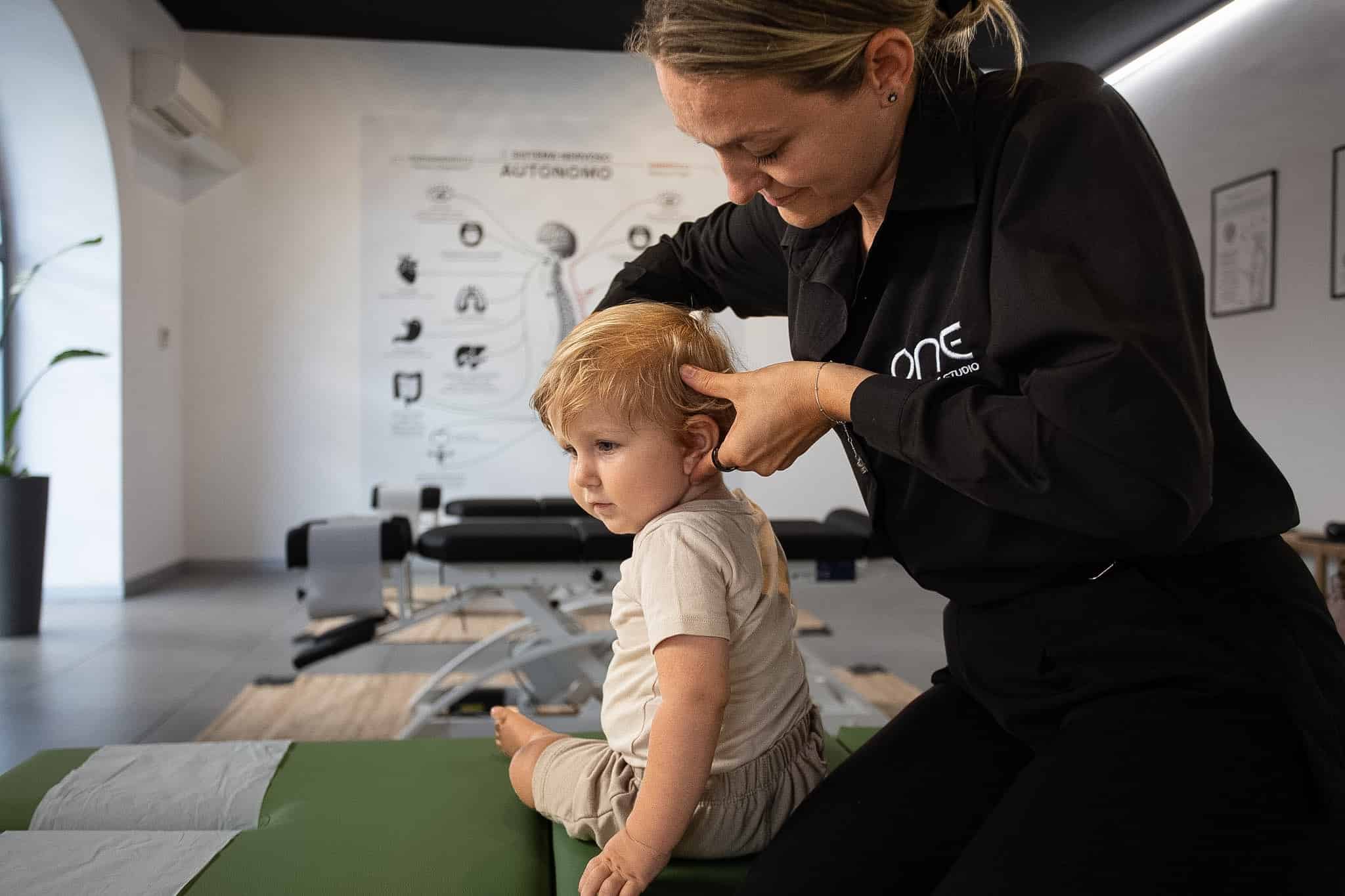
It is a question parents often ask quietly.
“Is my child too young?”
Then comes the opposite worry: “What if we have waited too long?”
We hear both questions every week from parents in Varese and the surrounding province, sometimes in the same phone call. Related links: ONE Chiropractic Studio Varese.
When Should You Take a Child to a Chiropractor?
The answer is that there is no fixed schedule. There is no age at which a chiropractic check becomes necessary, and nobody should present it that way.
What we can explain is when parents commonly contact us, what they noticed before booking and what we assess when the family comes to the clinic.
Four stages recur often. In each, children’s bodies change quickly and parents notice something new.
• The first few weeks after birth.
• The period when a child starts walking.
• Starting school, carrying a backpack and spending longer periods sitting.
• Adolescence, with sports and screen time.
None of these stages requires a chiropractic appointment. For a broader overview of pediatric chiropractic and how we work with families, see our complete parent guide. Here we focus on age. Related links: Pediatric Chiropractic in Varese: A Parent’s Guide.
Chiropractic and Newborns: How Young Are the Babies We See?
Some babies are just days old. Most arrive in the first weeks or months of life.
Often the reason is an observation rather than a diagnosis: a baby consistently turns their head to the same side, feeds more comfortably on one breast than the other or arches their back when placed down. Parents often notice such patterns first.
For newborns, assessment involves mainly observation and extremely light touch, comparable to checking the ripeness of fruit. Techniques for infants are entirely different from adult techniques. Our separate pediatric chiropractic safety and techniques page explains the approach.
An important point: we do not treat colic, reflux, ear infections or sleep disorders. These are medical concerns for the pediatrician. If your baby has symptoms, consult their pediatrician before booking with us.
First Steps and the Preschool Years
Between about one and five years old, children fall frequently as they learn to walk and play. In most cases, these tumbles leave no lasting problem.
Parents generally contact us about something else: walking that appears uneven, a consistent preference for one side during play or an unusual seated posture. These are observations, not medical diagnoses.
At this age, most of our assessment involves watching the child move. If we find no concern within our scope of practice, we say so and do not recommend a course of care.
What Is a Child’s First Chiropractic Visit Like?
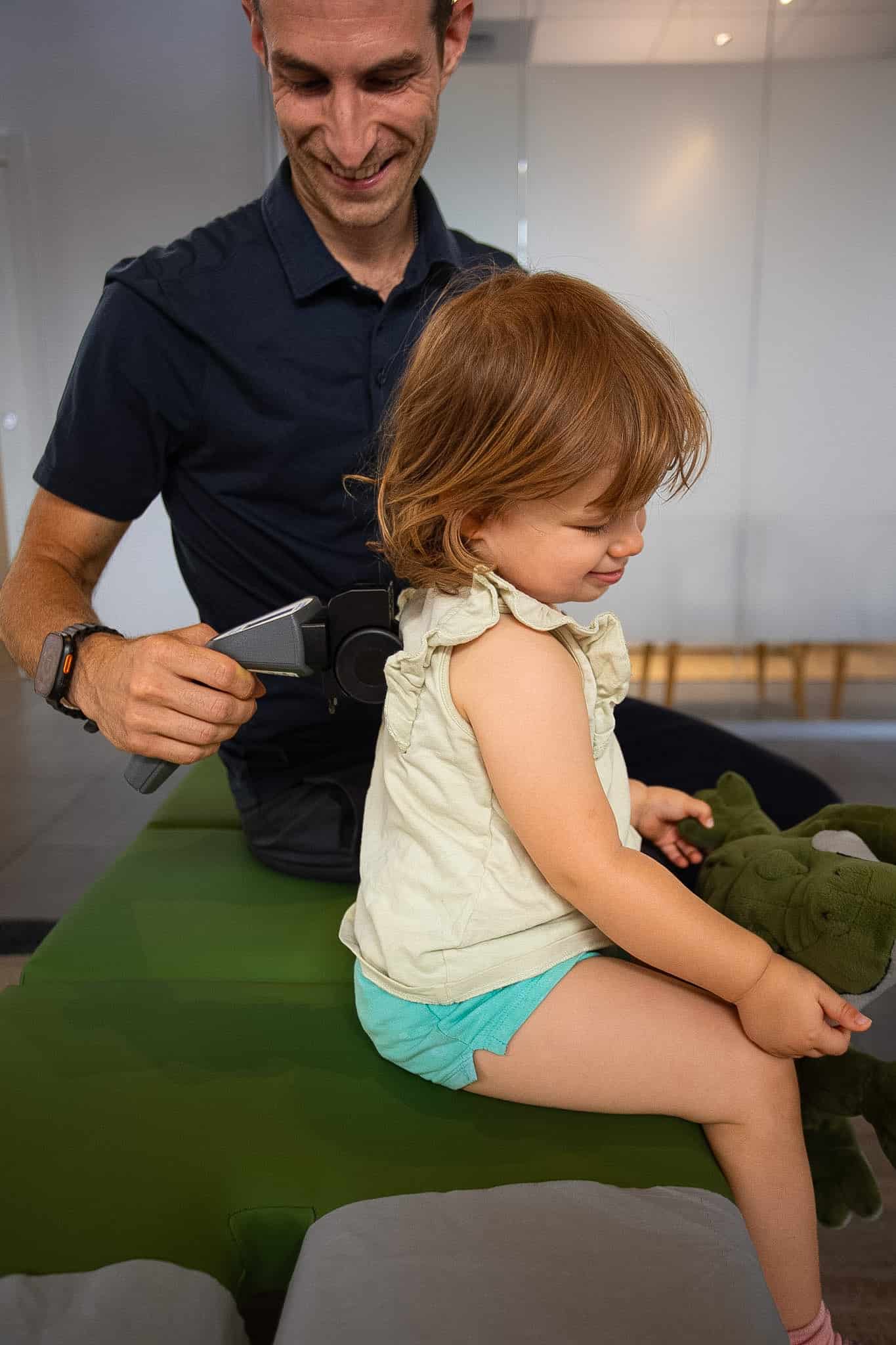
It lasts approximately 45 minutes and resembles a conversation more than a formal examination. We begin with pregnancy and birth history, the early months, movement milestones, sleep, feeding and play. We observe the child moving, often while they play, without expecting them to sit still. A parent stays throughout, and babies can remain in their parent’s arms. No medical referral is needed. The initial consultation costs €90, with follow-up visits at €70. If the assessment shows that we cannot help, the original clinic policy states that the consultation is free and we will suggest where to seek appropriate help.
What Do We Look at During a Child’s Spinal Assessment?
Less than you might expect from the word “spine”, but also a wider picture of how the body moves.
We look at how the head turns both ways, whether the pelvis moves comfortably, how a child rises from sitting and how they distribute weight while walking. We look for differences in movement, not so-called “vertebrae out of place”.
Research here is limited. A proposed relationship between spinal movement and nervous-system regulation is still a hypothesis, discussed in our guide to nervous-system regulation in children. It is not a proven mechanism. We do not promise changes to sleep, behaviour or growth. Related links: A Regulated Nervous System in Children: A Guide for Parents.
Adolescence: Backpacks, Sports and Screens
Parents may wait longer before asking about this age group, even as school and activities place new demands on the body.
A heavy bag carried on one shoulder, six hours sitting at school followed by evening training, and many hours with the neck bent over a phone are familiar examples.
Some teenagers report recurring stiffness or headaches. These symptoms should first be discussed with a pediatrician or sports physician. A chiropractic assessment, if relevant, follows and complements that medical evaluation.
When the Pediatrician Must Be the First Contact
There is no uncertainty about this.
Fever, inconsolable crying, unexplained weight loss or stalled growth, feeding refusal, delayed developmental milestones or a head injury require medical assessment by a pediatrician or emergency department. Not a chiropractic assessment, and not later: first.
Chiropractic care complements pediatric care. It does not replace or pre-empt medical assessment. We explain this even during the initial phone conversation.
Considering an Assessment for Your Child?
If you want to find out whether a visit would be suitable, calling the clinic is the fastest way. We will explain whether your concern falls within our scope. If you are still gathering information, start with the full guide to pediatric chiropractic in Varese. Related links: Pediatric Chiropractic in Varese: A Parent’s Guide.
At a Glance
No Mandatory Age
There is no age at which a chiropractic assessment automatically becomes necessary. Families visit us from the first weeks of life through adolescence, based on observations rather than a prescribed schedule.
Four Common Stages
The early weeks after birth, first steps, starting school with backpacks and more sitting, and adolescence with sports and screens. These are periods of rapid change, not required appointment milestones.
The Pediatrician Comes First
Fever, inconsolable crying, unexplained weight loss, feeding refusal or delayed movement milestones need pediatric assessment. Chiropractic care may complement pediatric care but never replace it.
Frequently Asked Questions

Written by Melanie Kleinhans
Doctor of Chiropractic · AIC Member · Bachelor of Chiropractic, New Zealand College of Chiropractic (2018)
Originally from Namibia, Melanie practised in the Netherlands before moving to Italy. At the clinic she particularly works with children and expectant mothers, and she is the mother of a one-year-old. Last updated: 5 August 2026. Meet the team. Related links: Meet the Varese Chiropractic Team.
ONE Chiropractic Studio Varese
Monday 15:30–19:00
Tuesday 08:30–19:00
Wednesday 08:30–19:00
Thursday 08:30–19:00
Friday–Sunday: Closed
Parking: Autosilo Sempione nearby · Find the clinic on Google · Instagram · Back to Chiropractor in Varese Related links: Find us on Google · Instagram · ONE Chiropractic Studio Varese.